By Team BLQ — Boatsafe Accredited Trainers, Boat Licence Queensland
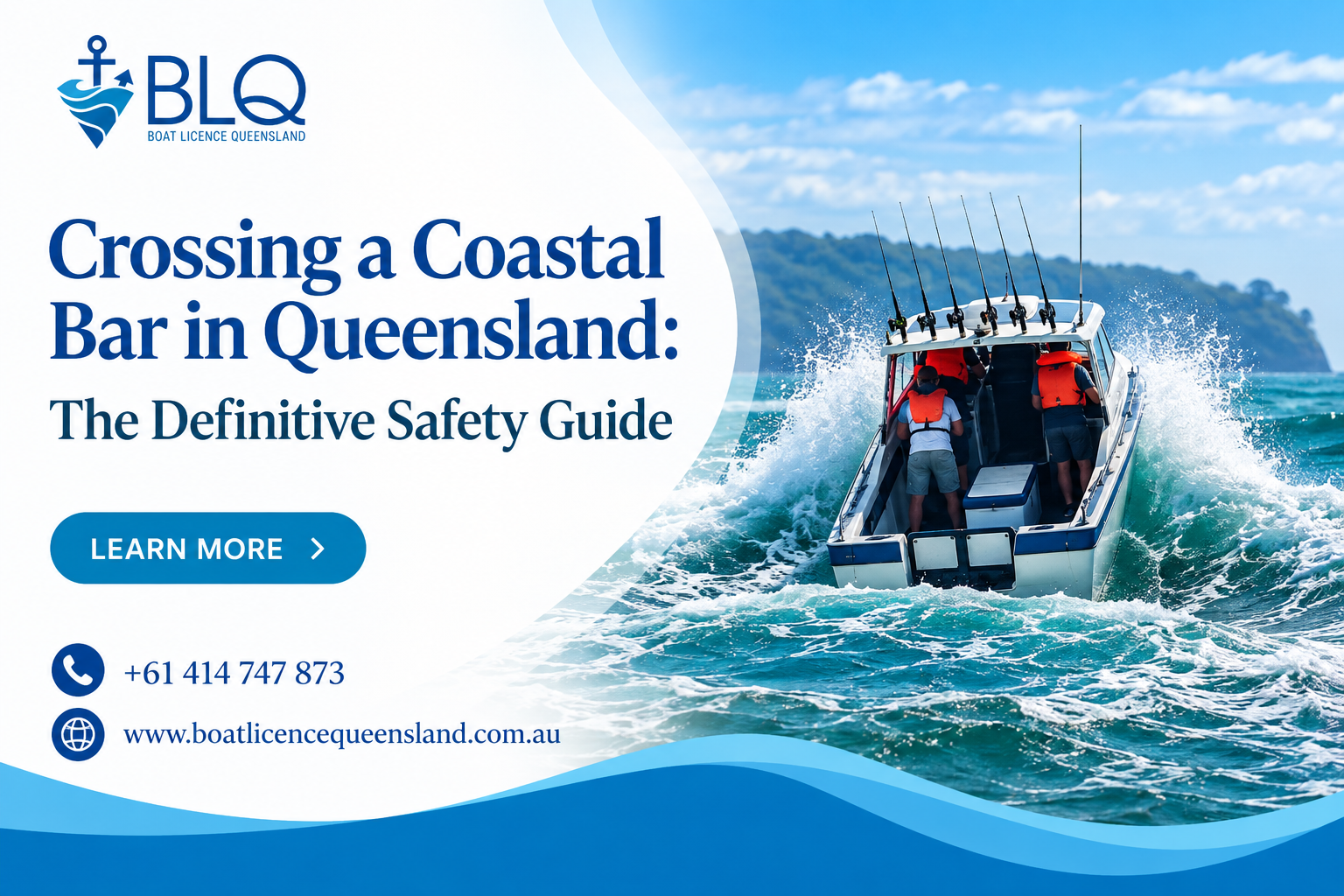
There are few moments on the water that demand more respect, preparation, and sound judgement, than crossing a coastal bar. Every year in Australia, boats capsize, people are thrown into the water, and rescue services are scrambled — often because someone underestimated conditions that looked manageable from shore. As accredited BoatSafe trainers with years of commercial skippering experience on Australian coastal waters, we know coastal bars are dangerous and challenging. This guide brings together the essential knowledge every Queensland Skipper needs before they attempt any bar crossing — whether it is the Gold Coast Seaway, Jumpinpin, Wide Bay, or any of the other designated bars along Queensland’s coastline.
What Is a Coastal Bar, and Why Is It Dangerous?
A coastal bar is a shallow sandy bank that is built up at the seaward entrance of rivers, lakes, and inshore waterways. Sand drifts along the coast and accumulates at these openings, creating a section of shallow, broken water where the ocean meets the calmer inshore channel. Queensland has many of these bars — they are often the only way vessels can access open water or find shelter from it.
The danger is not always obvious. Offshore conditions can be ideal — flat seas, light breeze, good visibility — while the bar itself is a seething mess of breaking waves just a few hundred metres away. The shallow water forces ocean swells to steepen dramatically. Waves that would roll beneath your hull in deeper water stand up, break, and tumble unpredictably when they hit the bar. Even small waves in these conditions can capsize, swamp, or sink a vessel. Sandbanks shift constantly, meaning the channel you crossed safely last month may no longer exist. Every bar is different, and every crossing demands fresh assessment.
The Number One Rule: If in Doubt, Do Not Go
Before any technique, any checklist, any tide table — this is the most important rule. If conditions look marginal, if you feel uncertain, or if anyone on board is worried — do not attempt the crossing. There are no fish, no destinations, or no schedules worth a life. The sea will always be there another day.
This is not just advice. Experienced commercial skippers with thousands of hours on the water turn back regularly. The decision to stay in is a mark of skill and judgement, not weakness. Maritime Safety Queensland is clear on this: vessels that are unable to safely handle adverse sea conditions outside the bar should not leave port.
If This Is Your First Bar Crossing
If you are considering venturing offshore for the first time and need to cross a coastal bar, do not attempt it in your own boat without having first gained experience crossing multiple times in another vessel skippered by someone who knows that bar in a variety of conditions. Conditions can change quickly and without warning, even on a good day. Even the Gold Coast Seaway — the most manageable bar entrance in southeast Queensland — can be particularly unforgiving on an ebb tide, with a building swell and a sea breeze.
The right way to build bar crossing experience is: cross as a passenger or crew with an experienced skipper first. Cross several times and in different conditions before attempting it alone. Learn the specific bar you plan to use — not just bars in general. Every bar has its own quirks, sandbanks, channels, and danger zones. Talk to your local Marine Rescue Queensland station, experienced local skippers, and fishers who cross that bar regularly before you ever attempt it yourself.
Timing Your Crossing: Tides Are Everything
The single most critical factor in bar safety — beyond vessel type or experience — is tide. The outgoing (ebb) tide is consistently the most dangerous time to cross any bar in Australia, and this cannot be overstated.
Why the ebb tide is so dangerous: When the tide runs out, water is funneling through the bar channel at significant speed — sometimes several knots. Ocean swells pushing in from offshore collide head-on with this outward flow. The result is steeper, more chaotic waves that stack up rapidly and break with little warning. This is the scenario that claims lives.
Cross on the incoming tide: An incoming tide works with you. The tidal flow moving inward suppresses wave height and creates calmer, more predictable conditions at the bar. Aim to cross close to the top of the tide when the water is deepest over the bar, reducing the risk of grounding and giving waves less opportunity to steepen and break.
Crucially, plan both directions. Many boaters leave early in the morning on a favorable tide but fail to account for what the tide will be doing when they return in the afternoon. Check tide times for departure and return before you leave the ramp.
Wind, Swell, and the Prevailing Sea State
Tide is everything, but wind and swell compound the danger significantly. One of the most dangerous combinations at any bar is a run-out tide, a strong onshore wind, and a building swell — and this combination is exactly what catches out boaters who leave in calm conditions, and return hours later to changed weather.
Wind against tide: When wind pushes water in one direction and tidal current pulls it the other, seas become short, steep, and unpredictable. Even moderate wind speeds of 15–20 knots can create dangerous breaking waves on a bar when opposed by an ebb tide.
Swell direction: A swell running directly onto the bar from the ocean is far more manageable than a swell arriving at an angle. Angled swell creates cross-seas that hit your vessel from the side — one of the most dangerous orientations on a bar.
Check forecasts before you go: Use the Bureau of Meteorology’s coastal waters forecasts for your region, available on their website and via VHF radio. Check both wind speed and swell height — and check again for the time of your return, not just departure. Seabreeze.com.au provides excellent real-time wind and swell data for all Queensland bar locations.
Watching the Bar Before You Go: Webcams and Live Conditions
One of the best tools available to Queensland skippers is the ability to observe a bar live before departing — either in person or via webcam. Walking down to the break wall or headland and watching multiple wave sets pass through is always the gold standard. But for many Queensland bars, live webcam feeds are also available through the Bureau of Meteorology’s coastal infrastructure, allowing you to assess current conditions from shore or from home before you even launch.
If you can, observe the bar across different tides and weather in the days before your planned crossing. Watching other vessels — particularly similar-sized boats cross successfully helps you judge the channel, the wave interval, and the break zone. If no boats are going through, ask yourself why.
For the Gold Coast Seaway, Mooloolaba, Noosa, and several other Queensland bars, webcam coverage is regularly available. Check Seabreeze.com.au or similar sites, under the ‘Cams’ tab for current feeds relevant to your departure point.
Is Your Vessel Suitable for a Bar Crossing?
Not all boats are created equal when it comes to bar crossings, and vessel suitability is one of the most important factors that skippers underestimate. Before you consider crossing any bar, honestly assess whether your vessel is capable of handling breaking surf conditions.
Hull type matters: High-speed planing hulls — capable of 18 knots or more — and displacement hulls handle bars very differently. A planing hull has the speed to match wave pace, adjust position on the back of a swell, and accelerate through lulls with control. A displacement hull is slower and more at the mercy of wave energy. This directly affects technique: planing boats can often match wave speed coming in, while displacement vessels must come in very slowly to avoid being picked up and surfed.
Minimum requirements: Your vessel must be seaworthy, in good mechanical condition, and designed to take some impact from waves. A small open tinnie with a worn steering cable and a bilge pump that hasn’t been tested is not a suitable bar-crossing vessel, regardless of conditions. Check steering responsiveness, throttle control, bilge pump function, and the integrity of all hatches and drains before any offshore departure.
Freeboard and self-draining: Low freeboard boats are more susceptible to swamping when taking water over the bow. If your vessel’s cockpit does not self-drain, a single breaking wave can put you in serious danger. Know your vessel’s limitations and err strongly on the side of caution.
Aluminium plate boats and tinnies: These are among the most common vessels on Queensland bars. They can handle moderate bar conditions well — but their light weight also means they are more vulnerable to being thrown by a breaking wave. Many experienced fishers regard a 5–6 metre well-built aluminium plate boat as a capable bar-crossing vessel in suitable conditions. A 3.5–4 metre tinnie is a very different proposition, and may require exceptional conditions and caution to cross.
Heading Out: Technique for Leaving Through a Bar
Going out is generally the safer direction, but it still demands proper technique and preparation.
Before you leave the ramp or marina:
- Check the weather forecast and current live conditions
- Check tide times — cross on the incoming or high slack tide
- Log on with your local marine rescue service on VHF Channel 16 or 73. In Queensland, VMR and the Australian Volunteer Coast Guard have been merging throughout 2025–2026 into the new Marine Rescue Queensland (MRQ). Your local station may operate under the VMR name, MRQ, or a Coast Guard flotilla depending on where you are and how far the transition has progressed — but the contact channel and the service remain the same. Give them your vessel name, description, number of people on board, and destination
- Do a crew safety briefing
- Ensure all passengers have access to the correct type of life jackets, check size and fitting. Have them on or ready well before you approach the coastal bar
- Secure all loose gear, close hatches, and check bilge pumps
- Anchors tied down if potential to come loose
- Trim your motor all the way down for maximum control
Brief your passengers before the bar:
Before you reach the bar, take a moment to brief everyone on board — especially anyone who hasn’t crossed before. Tell them where the safety equipment is stored, confirm their lifejacket is correctly fitted and fastened, tell them to hold on firmly with both hands, stay seated, and to not move around the vessel until you give the all-clear. In the event of a capsize, remind them to stay with the vessel if possible, as a floating boat is far easier for rescuers to locate than a person in the water. A calm, brief pre-bar briefing costs thirty seconds and can be the difference in an emergency.
At the bar entrance:
- Stop and watch before you commit. Stand off and observe the wave sets for at least 10–15 minutes. Sets of larger waves are followed by calmer periods — time your departure for one of these windows
- Identify the deepest water channel and any leads or beacons that mark the safe route
- Wear polarised sunglasses if you have them — they can significantly help you read the water depth and identify the safest channel through the bar
- Approach waves at 90 degrees — head-on. Never approach at an angle if you can avoid it, as a wave on your beam can roll a vessel that might otherwise ride through safely
- Maintain enough speed to stay in control, but do not race. Excess speed through a breaking sea can launch a vessel dangerously
- The key principle is to match your vessel speed to the energy and movement of the waves to maintain control. Time your run through a lull between wave sets, applying power progressively rather than maintaining constant throttle
- Be prepared to have to punch through some waves: When heading out you are likely to meet oncoming waves head-on. Reduce speed and ease the bow into each wave at a controlled pace rather than driving hard into the base — this can bury the bow dangerously. Also try to avoid too much speed and jumping the vessel over the wave. Let the vessel climb the face. Once through the crest, be ready for the next set
- Do not turn back once you have committed and a wave is approaching. Attempting to turn in front of a breaking wave puts your beam to it — which is when capsize becomes a real risk. Keep going forward
- Once through the break zone, be aware of shallow banks just outside the entrance.
Coming Back In: The Greater Danger
Coming back in through the bar is widely regarded as more dangerous than going out, and this is where many serious incidents occur. The temptation to push on after a good day, even when conditions have worsened, is strong — and often fatal.
Stop and watch before you enter. This is non-negotiable. Lay off from the bar at a safe distance and observe the wave patterns. Watch multiple sets go through. Look for the deepest water and the most consistent channel. Do not rush this.
Do not surf. The most dangerous mistake when heading in is to allow your vessel to be picked up and surfed on a wave. A displacement vessel running down the face of a breaking wave can lose steering entirely, broach side-on, and capsize. Control your speed carefully — for displacement hulls, this often means coming in slowly, allowing waves to pass under you rather than being caught on them. High-speed planing hulls have more options: a boat capable of 18 knots or more can match wave speed and hold a controlled position on the back of the swell. If a wave begins to push your stern, apply power carefully to try to stay on the back of the wave, not the face.
Sit on the back of the swell. The safest position when entering is on the back of a wave as it moves ahead of you. From this position the wave is between you and the open sea, you can see clearly into the bar, and you can maintain control of your speed. Do not chase waves or try to ride them in. Maintain a speed that matches the movement of the wave to remain on the back of the swell and avoid being carried forward.
Never run side-on to large waves. A vessel beam-on to a significant breaking wave will almost certainly roll. If you find yourself in this position, use power immediately to swing bow or stern into the wave. Always choose bow-on or stern-on over beam-on.
When conditions prevent a safe return: In bad conditions, it can be safer to stand off in deeper water rather than attempt to cross. If you lay off the bar and assess that it is not safe to cross, do not let impatience, fading light, or fatigue push you into a bad decision. Your options are: wait for the tide to turn; wait for conditions to improve; or make for an alternative port or anchorage. Many Queensland bars are within reasonable range of an alternative safe harbour. Know your alternatives before you depart, ensure you have sufficient fuel to reach them, and brief your marine rescue contact so they know your revised plan.
Log off with your marine rescue service once safely inside. This is both courtesy and critical safety practice — it lets the rescue service know you are safe and allows them to focus resources on vessels still at sea.
Queensland Life Jacket Laws: What Is Required at a Bar
Lifejacket requirements vary between Australian states. The following reflects current Queensland legislation and Maritime Safety Queensland (MSQ) guidance.
Queensland’s life jacket laws changed significantly from 1 December 2024. Every skipper needs to understand them.
Bar crossings — mandatory wearing for everyone: From 1 December 2024, it is compulsory for everyone on board to wear a life jacket when crossing a designated coastal bar on an open vessel, or in any open area of a vessel of any length. This applies regardless of your boat’s size. The legislation is found in the Transport Operations (Marine Safety) Legislation Amendment Regulations.
Life jacket types: Queensland law requires each person to wear the correct lifejacket for their vessel, activity, and operating waters. The rules differ clearly between boats and PWCs:
Boats — Bar crossings: Everyone on board must wear a correctly fitted AS 4758 Level 100 or higher lifejacket. when crossing a designated coastal bar on an open vessel, or in any open area of a vessel of any length. This applies regardless of your boat’s size. Level 100 is designed to keep a person afloat even if unconscious and provides high visibility.
PWC — Bar crossings: PWC riders must wear a Level 50 lifejacket at all times whilst crossing a coastal bar.
Extra PWC information – In smooth waters, a Level 50S is the minimum lifejacket required. In partially smooth or coastal waters, a Level 50 is required. Importantly, Level 100 lifejackets are not to be used for PWC riders under Queensland regulations — the bulk and collar design of a Level 100 can cause injury during high-speed water entry on a PWC.
Why wearing lifejackets matters beyond the law: In the five years from 2019 to 2023, there were 64 boating fatalities in Queensland. Only 5 of those people were known to be wearing their life jacket at the time. A capsize on a bar can happen in seconds — a breaking wave does not give warning. Attempting to retrieve and put on a life jacket while in rough water is, for most people, impossible. Put it on before you reach the bar. Fasten it properly. Do not take it off until you are safely back in sheltered water.
Queensland’s Designated Coastal Bars: Know Before You Go
Queensland’s most significant bars for recreational boaters in the southeast corner include:
Gold Coast Seaway — Generally regarded as one of the more manageable bar entrances in SE Queensland in suitable conditions, but do not be complacent. The outer bar stands up rapidly when swell meets the ebb tide. Log on with your local marine rescue station (currently transitioning from VMR Southport to MRQ Southport) or the Seaway Tower on VHF 16/73 before crossing. Avoid heading northeast immediately after the heads — a shallow bank with breaking waves sits just a couple of hundred metres off the entrance.
Jumpinpin Bar — Between South and North Stradbroke Islands. One of Queensland’s most notorious bars. Advice from experienced local skippers is consistent: unless you have strong local knowledge and near-perfect conditions, take your vessel to the Gold Coast Seaway instead. If you do attempt it, log on with your local marine rescue service — MRQ Jacobs Well (formerly VMR Jacobs Well, which transitioned to MRQ in December 2024) — on VHF 16/73 before and after. Only cross on a very small swell.
South Passage Bar — Between North Stradbroke and Moreton Islands. Comparable danger level to Jumpinpin. Sandbanks shift constantly. Multiple channels exist, each with different hazards — seek current advice from your local marine rescue service at North Stradbroke (MRQ North Stradbroke Island, which transitioned in April 2025). A partially exposed shipwreck (Rufus King) adds further hazard in the middle channel.
Wide Bay Bar — One of Australia’s most treacherous bars, and the gateway to the Great Sandy Strait. The notorious “Mad Mile” section can change rapidly. Cross only at high tide in settled conditions. Allow up to 30 minutes for the full crossing.
Mooloolaba and Noosa Bars — Both are dynamic and require experience. Mooloolaba is particularly unpredictable in moderate swell. Noosa is generally unsuitable for keel yachts.
Before Every Bar Crossing: The Essential Checklist
- Weather forecast checked — wind, swell, and conditions for both departure and return
- Tide times confirmed — crossing planned for incoming tide or high slack
- Marine rescue service logged on (VHF 16/73) — vessel name, description, persons on board, destination
- Life jackets on, fastened, and correct type for all on board.
- All passengers briefed — safety equipment locations, hold on standing or stay seated, what to do in a capsize
- Loose gear secured, hatches closed, bilge pumps checked
- Anchors tied down if potential to come loose
- Vessel in good mechanical condition — steering, throttle, engine recently serviced
- Engine trim set all the way down
- Polarised sunglasses on for reading the water
- Local knowledge sought if unfamiliar with the bar
- Bar observed from shore or lay-off position before entering — including checking live webcam if available
- Conditions acceptable — if not, the decision is made to wait
- Alternative safe harbour or plan identified in case conditions prevent a safe return crossing
- Sufficient fuel and vessel reliability to allow for delays, diversions, or aborted crossings
A Final Word
Coastal bars are not places to test your confidence or prove a point. They are places where the ocean demonstrates its indifference to plans, experience, and good intentions. Every skipper, regardless of hours on the water, approaches a bar with humility, preparation, and the willingness to turn back.
The best crossing you will ever make is often the one you decided not to do.
At Boat Licence Queensland, our BoatSafe training covers bar crossing theory, life jacket requirements, tidal planning, and wave reading as part of the full Recreational Marine Driver Licence and Personal Watercraft Licence course. For course bookings at Gold Coast (Southport) or Brisbane (Manly Marina), visit www.boatlicencequeensland.com.au or call 0414 747 873.
Sources: Maritime Safety Queensland (msq.qld.gov.au), Marine Rescue Queensland (mrq.qld.gov.au), NSW Government Coastal Bar Safety